I built CourseKey’s platform. It exited for $30M. Now I join SaaS teams.
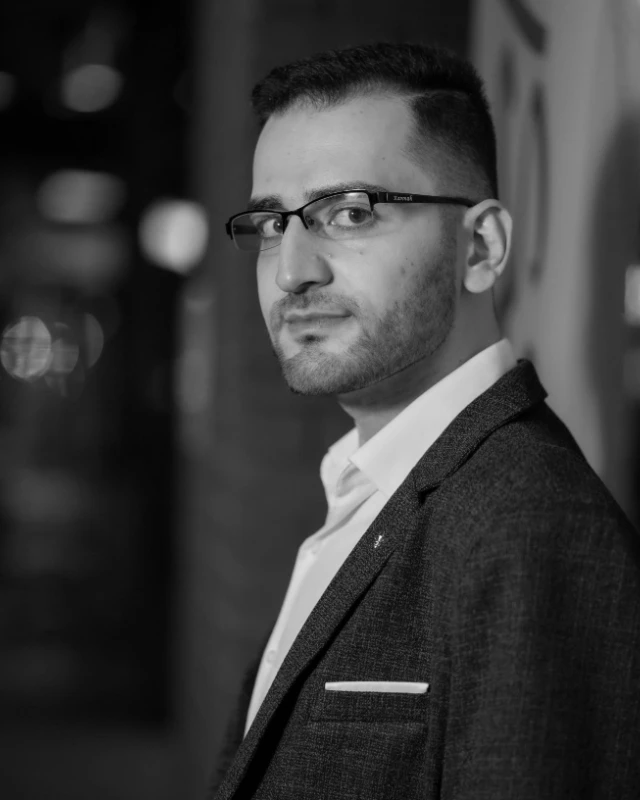
I’m Fadee Kannah, technical co-founder of CourseKey. I architected the platform and led the engineering team, and in January 2025 it exited to private equity firm PSG. Today I consult for Portico, American Growth Insurance, Atomic, and other SaaS teams.
- $30MCourseKey exit to private equityPSG, January 2025
- $9MSeries B led by SignalFireMarch 2021
- 200+career colleges on CourseKeyBy March 2021
- 2US patents as co-inventorGranted 2019 and 2020
PSG announced its investment in CourseKey on January 7, 2025 (announcement, opens in a new tab). The raise and the college count are from TechCrunch, opens in a new tab. The patents are US10212542B2, opens in a new tab and US10551496B2, opens in a new tab.
Where I started
2006 to 2014
I was born in Bartella, a small town east of Mosul, and spent my childhood in Baghdad. In 2006 my family moved back to Bartella because Baghdad was no longer safe. In 2008 we moved to Turkey and applied through the United Nations to be refugees in the United States. Within nine months we had visas.
I started US high school as a sophomore, with no records for my first year and a half, and the placement exams put me in the lowest level of English as a second language. A deal I made with the counselors got me through the whole program in half a year, and I graduated on time, at the top of my class. The full story is further down.
At San Diego State I studied computer engineering with a computer science minor, ran student organizations and computer labs, and worked as a teaching assistant. On the side I built websites and software for paying clients. That is where I met the people I started CourseKey with.
CourseKey, and the exit
2014 to 20252021 raise
CourseKey is software for career schools. Luke Sophinos and I started it while I was still at San Diego State. I was the technical co-founder: I architected the platform and led the engineers who built and ran it. When CourseKey raised a $9M Series B in March 2021, more than 200 career colleges were using it, and TechCrunch, opens in a new tab credited me with architecting the platform.
I’m a named co-inventor on two US patents for verifying attendance: one that uses a geofence, opens in a new tab (granted 2019) and one that uses sound, opens in a new tab (granted 2020).
In January 2025, CourseKey took a $30M exit to private equity firm PSG, which announced its investment, opens in a new tab on January 7. “Fadee is a code magician. He can turn any idea into reality in a scalable way. And he’s been doing it with me for more than a decade.”
MeetingHero, and why I shut it down
December 2024 to October 2025
In December 2024 I started building MeetingHero.ai, an AI tool that researched the people you were about to meet and put a briefing in your calendar or inbox. I launched it in May 2025 and relaunched it in July.
It never became a business. I served 39 users. Heavy users cost more in AI usage than the lighter users could cover, and AI costs fell more slowly than I had assumed. People had grown tired of paying for AI tools, I couldn’t explain why mine was better than asking ChatGPT directly, and referrals and outreach didn’t bring in enough new users. I shut it down in October 2025, and I wrote up what went wrong, opens in a new tab.
Consulting today
Now
For two years I’ve been the embedded engineer for the Success team at Portico, whose four products include CourseKey (Portico case study). For American Growth Insurance I built an AI assistant into their existing app in 4 weeks (American Growth Insurance case study). I also work with Atomic and other SaaS teams.



The three ways I work with a team are on the homepage.
The longer story: school and early code
School
For me, education is an ongoing process. From an early age I have wanted to learn about everything, from how history shaped our societies to how atoms work. From sneaking out of class to spend time in the library, to reading my dad’s college books, I always found a way to learn something new. That passion led me to programming, to co-founding CourseKey, and to where I am now.
I spent fifteen years in school in Iraq. My elementary school was nothing special, but my effort did not go unnoticed. I ranked top of my school, which let me apply to Al Mutamayizeen Secondary, opens in a new tab. To get in, I had to pass multiple comprehensive academic and IQ tests and score in the top 100 of the applicants. It was the hardest thing I had done, and I spent my entire summer preparing. The tests covered science, math and language, and ran for multiple days, eight hours each.
Because of the war I had to move from Baghdad to Bartella, opens in a new tab, so I could not continue there. I kept teaching myself about computers and technology. My time at the new secondary school was short, because I left the country.
When I came to the US I started as a sophomore, which meant I had missed a year and a half of school. After the placement exams I was put in the lowest level of the English as a second language (ESL) program. I would have had to go through all four years of it before taking regular freshman English, and the counselors and teachers expected me to spend my remaining high school years finishing it.
I did not like that plan. After a couple of weeks in the entry class I had become a translator and teaching assistant for my classmates. My teacher noticed and moved me up to the beginner level. I was still not satisfied. I knew I could be in a higher level, and spending years to get there was not an option.
I spent most of those months in front of the counseling office, trying to convince them to move me up. Because of how I did in the beginner class, my teacher helped me skip not one but two classes. Then I made a deal with the counselors. During the summer I would take regular freshman English, skipping the rest of the ESL program. If I passed, I would continue normally. If I failed, I would stop bothering them and take every ESL class.
I passed, ranking first in the class with an A+. Within half a year I had finished the whole ESL program and freshman English. After that I set my goals higher. Catching up to my peers was no longer enough, and I wanted to go straight from high school to university, which meant making up almost two years.
I never missed a summer school session and took every opportunity to take a class: online classes, after-school classes, even college classes, plus honors and Advanced Placement courses. I graduated within two and a half years, ranked at the top of my graduating class.
San Diego State accepted me as a computer engineering major. I soon found it was not challenging enough, so I added a computer science minor, joined student organizations, started my own, managed computer labs, became a teaching assistant and worked for the university. Alongside all of that I ran my own software development business and managed another.
Classes started to feel slow, because I already knew the material before taking them. I needed an environment where I was always learning, and building CourseKey was that environment. I took a break from school to do it, and finished my computer engineering degree in 2019.
Teaching myself to code
Since I was a kid, I liked solving problems, breaking things and putting them back together. When I got my first computer, I took it all apart and put it back together. The next day, my curiosity got the better of me and I deleted Windows. I spent my allowance on software and video games, and playing with them taught me editing, animation, 3D modeling, working with data and much more.
When I came to the US, I got access to the internet, the only thing that could satisfy my curiosity. As a teenager I went headfirst into gaming, and I started modding game files: my own models, skins and maps. That pushed me to learn how memory, assembly and machine code work, and then to start writing my own programs.
I started making websites, which forced me to learn how everything underneath them worked: compiled versus run-time languages, client-server communication, networking, and how TCP works. By the time I was a freshman at the university I had joined computer science and engineering student organizations, from robotics to mobile and game development.
In my intro to C programming class I used an Arduino Uno for my projects instead of a plain C program. I wanted to control things from my phone, so I built a Wireless Arduino LED Piano, opens in a new tab with three pieces of software.
My classes were teaching me things I already knew, in a more structured way, so I had free time to experiment. I made apps from simple to-do lists to an online shopping store. I bought a Raspberry Pi and built a server that hosted Git, ownCloud, network file sharing, a PHP web server and a MySQL database, and later turned it into a media center and a personal streaming server.
I made many apps over the years. Some I forgot about, some were valuable to me and to others, and some just satisfied my curiosity. I built an app for Warframe that helped players spend less time researching and more time playing, and YouTube Redirector, opens in a new tab, a Chrome extension I made to learn how extensions work.
Most of what I built back then was experimentation, to learn tools and feed my hunger for code. That is how I went from a curious gamer to a software developer.
The technical write-ups behind this work are in the showcase. Browse the technical showcase
Tell me what you’re trying to ship.
Free · no prep needed · proposal in 48h